This is the question that stops more projects than any other, usually at the point where a client asks whether the mark is safe. The short answer is yes: you can set a logo in a font from this site, trademark it, and sell the work. The two things worth understanding are what the licence actually covers and what it does not protect you from.
This is a description of what the licences say. It is not legal advice, and a mark that matters commercially deserves an actual lawyer.
The licence covers the file, not the letterforms you draw with it
A font licence is software licensing. It governs copying, modifying and redistributing the font file. It does not claim ownership of the words you set with it, any more than a licence for a drawing program claims ownership of the drawings.
The SIL Open Font License, which nearly every font on this site uses, says this explicitly: documents embedding the font are not subject to the licence. A logo is a document in that sense. You can trademark it, register it, and enforce that trademark, and the font designer has no claim on your mark. What the OFL allows goes through the rest of the terms.
Caveat one: you cannot stop anyone else using the same font
A trademark protects your mark as a whole — the name, in that treatment, in your field. It does not give you the typeface. Somebody else can set a different word in the same font, and somebody in a different industry can set a similar word.
That matters more with a popular open font than with a licensed one, because the barrier to using it is zero. It is an argument for customising the letterforms rather than for avoiding open fonts: draw the mark, then modify the outlines until it is yours. That is permitted, and it is what most studios do anyway.
Caveat two: check the character set before you commit
A logo usually needs more than the letters in the name — a registered symbol, an ampersand, an accent, a currency mark for the strapline. Display faces in particular are often drawn for one alphabet and one case. Every font page here shows a character map read from the file itself, so you can look rather than assume. Finding out after the brand guidelines are printed is the expensive version of this check.
What about client work?
You can hand the font file to the client, put it in the brand package, and let their printer and their agency use it. No fee, no seat count, no renewal, and no need to ask anybody. The one condition is that the licence file travels with the font — it is inside every download here, and leaving it in is the whole of the obligation.
This is the practical reason a lot of studios have moved to open fonts for identity work. A licensed typeface means the client buys seats, buys again for the web, and buys again when they hire an agency. An open font means the identity works everywhere on day one.
Faces that hold up as a logotype
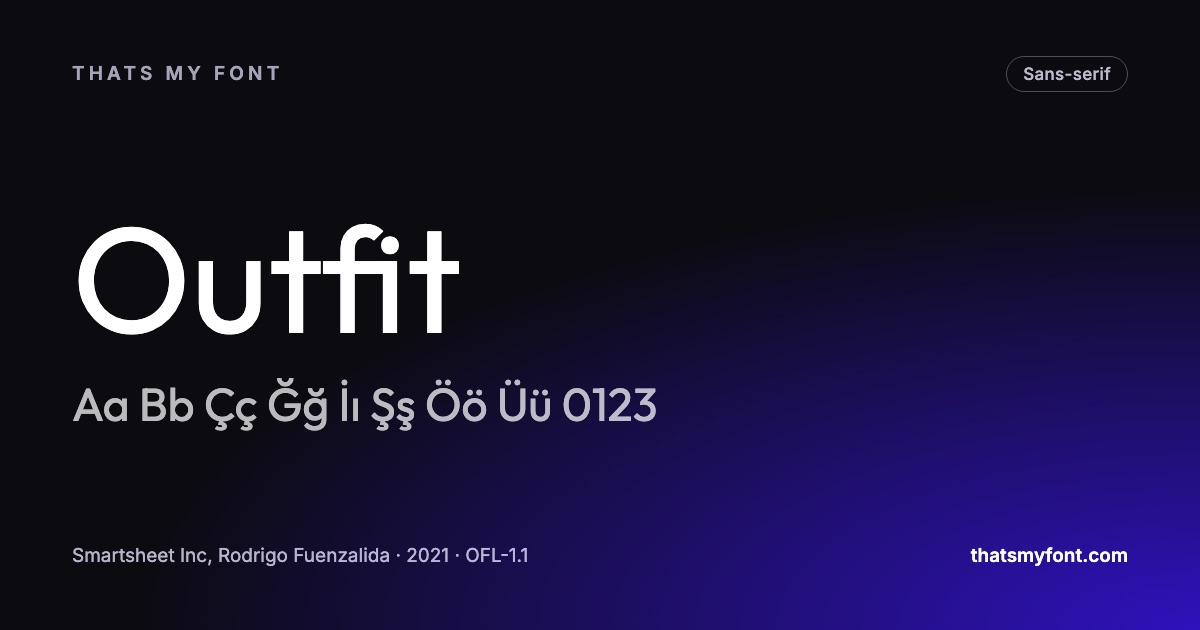
A logo is set once, large, and looked at for years, which is a different job from body text. Weight range matters less than whether the letters have anything of their own. Outfit and Manrope are geometric enough to feel deliberate without being loud. Playfair Display does the opposite job for something that needs to feel established. Bebas Neue is condensed capitals and has become a default for exactly that reason, which is itself a reason to modify it.
| Family | Variable download | Static download |
|---|---|---|
| Outfit | 58 KB1 file | 270 KB9 files |
| Manrope | 69 KB1 file | 292 KB7 files |
| Playfair Display | 270 KB2 files | 1.0 MB12 files |
| Bebas Neue | None published | 30 KB1 file |
Redrawing the letters, and what it does to the licence
Almost every wordmark made from a typeface gets adjusted: a letter narrowed, a join tightened, a terminal cut. The Open Font License permits that explicitly — it allows modification — and the artwork you end up with is yours.
The condition attaches to font files, not to drawings. If you modify the font itself and pass that file on to somebody else, the modified font stays under the same licence and cannot carry the original’s reserved name. A logo exported as outlines is not a font file, so none of that applies to it: it is artwork, and you own the mark you made.
Registering the mark
Trademark offices examine the mark — the specific arrangement of letters, colours and shapes you are claiming — not the typeface it was set in. A wordmark set in a widely available font is registrable, and thousands are. What the office cares about is whether the mark is distinctive enough in your trade, and whether somebody else is already using something confusingly close.
Two practical consequences. Distinctiveness usually comes from what you did to the letters, the colour and the lockup rather than from the font itself, so the adjustments above earn their keep twice. And using an open font removes one line from the examiner’s list of things that could complicate the filing: nobody has to license the typeface for the registration to proceed.
Making it reproducible in ten years
A logo outlives the machine it was drawn on. What kills a mark is not licensing, it is a rebuild in five years’ time where nobody can find the font, the version has changed, and the new one is a few units wider.
- Archive the exact font file you used, together with its licence text. The zips on this site contain both.
- Note the version and where it came from, in a text file beside the artwork.
- Keep the final logo as outlines as well as editable type, in a vector format.
- Record the sizes and spacing you settled on, so a redraw starts from your decisions rather than from scratch.
All of that is permitted with an open font and awkward with a commercial one, which is the quiet reason so many marks are built on them. If a client later wants something nobody else has, a logo is the one place where commissioning a custom drawing is genuinely worth it — see font licensing for client work.